Methodology
Eight signals. One number from 0 to 100. The same algorithm for every business. The heaviest signal is whether AI can retrieve you at all — because that is the literal input to every recommendation. No money moves the score.
- 08
- Signals scored
- 100
- Point scale
- 26%
- Weight on retrievability
- 0
- Paid placements, ever
The thesis
One number. One mechanism.
AI assistants don’t recommend the closest business, the prettiest website, or whoever paid the most. They recommend a business they can retrieve and recognize as real: one that many independent, trustworthy sources describe the same way.
Because retrieval is the gate everything else passes through, the single heaviest signal is whether you appear in the results an AI model pulls from when it answers. Everything else either earns that retrievability or refines what the AI says once you’re in.
Retrievability isn’t one ranking factor among many. It’s the precondition for all of them.
How a recommendation is assembled
“best med spa near me”
The weights
How much each signal weighs.
Eight signals, identical for every business, ordered by how much each one moves an AI recommendation. The single heaviest is whether you can be retrieved at all.
Retrievability and the attestation that earns it are the retrieval tier — together 46% of the score. Nearly half.
The formula
Eight signals become one number.
We don’t average them. The method leans on the weakest signal, so a strong one can’t cover for a poor one.
- Retrieval grounding72
- Off-property attestation65
- AI visibility48
- Reviews & response80
- Backlink & citation authority55
- Google Business Profile90
- Speed & mobile68
- Content freshness & schema75
Lose retrieval, and the score follows.
Retrieval is the heaviest signal. Drop it from 72 to 20 and the score falls from 67 to 48. A simple average would still read 55. Strong signals would be hiding a weak one.
AI Score = 100 · exp( Σ wᵢ · ln xᵢ )
The eight signals
Every signal, in detail.
Retrieval tier
Retrieval grounding
Whether you sit inside the ranked set an assistant actually retrieves and cites. Measured across AI-Overview citations, organic top-10 presence for your money queries, and the Bing index ChatGPT leans on.
sim(q, p) = (E_q · E_p) / (‖E_q‖ ‖E_p‖)
Ahrefs: 38–76% of AI-Overview citations come from organic top-10; ChatGPT matches Bing’s top results ~87% (Seer).
Retrieval tier
Off-property attestation
What others say about you off your own website. This is the attestation that trains retrievers to surface you. Volume, consistency, and source quality across mentions.
Ahrefs (75k brands): YouTube mentions correlate ρ≈0.74 with AI visibility and branded mentions 0.66–0.71, far above backlinks at 0.22. Correlation, not causation.
Recognition tier
AI visibility
Whether the major assistants name you when asked the questions your customers ask, and whether they name you for the service you actually want to be found for.
Probed monthly across ChatGPT, Gemini, Perplexity, and Google AI Overviews.
Recognition tier
Reviews & response
Volume, velocity, the specificity of review language (“great with anxious dogs” beats “5 stars”), and how consistently you respond. AI quotes named services, not star counts.
specificity = entity/keyword density of review text
Whitespark 2026: review signals ≈16% of the local pack and rising.
Recognition tier
Backlink & citation authority
Where you’re named across the web and how authoritative those sources are. A citation in the New York Times is worth a thousand on a link farm.
Weighted by domain authority and editorial quality, not raw link count.
Technical tier
Google Business Profile
Completeness of every required and recommended field, plus how fresh it is. A complete profile untouched for two years scores worse than an incomplete one updated last week.
Whitespark 2026: GBP signals ≈32% of the local pack.
Technical tier
Speed & mobile
How fast and stable your site feels on a real phone, at the 75th percentile of real users, against the thresholds Google publishes.
Core Web Vitals thresholds per web.dev (LCP 2.5s · INP 200ms · CLS 0.1).
Technical tier
Content freshness & schema
Whether the site is current and answers the questions people ask now. Also the technical plumbing that lets machines read it cleanly: valid structured data, canonicals.
Every business website re-crawled on a 28-day cadence; schema validated continuously.
Methods referenced
We didn’t invent the maths.
Every part of the score is a named, published method, borrowed from information retrieval, index construction, and game theory, and each one is cited.
Fig. 8 — Methods composing the AI Score · n = 10 · 3 stages · full citations
RAG
p(y|x) ≈ Σ pη(z|x)·pθ(y|x,z)
Defines why retrievability is the gate: the answer is written over the top-k retrieved documents.
Lewis et al., NeurIPS 2020
DPR + cosine
sim(q,p) = E_q·E_p / ‖E_q‖‖E_p‖
Dense dual-encoder retrieval; cosine similarity models query–business relevance.
Karpukhin et al., EMNLP 2020
BM25 / TF-IDF
Σ IDF·tf(k₁+1) / (tf + k₁(1−b+b·|d|/avgdl))
The lexical baseline behind literal-match retrievability.
Robertson & Zaragoza 2009 · Spärck Jones 1972
LUKE (entity-aware)
h_e = softmax(Q_eK_eᵀ/√d)·V
Why precisely described entities are retrieved over generic pages.
Yamada et al., EMNLP 2020
PageRank
PR = (1−d)/N + d·Σ PR(j)/L(j)
Classic link authority. Now one input among many, and the foil for entity retrieval.
Brin & Page, 1998
Reciprocal Rank Fusion
RRF(d) = Σ 1 / (k + rᵢ(d)), k = 60
Fuses multiple ranked signal lists into one composite (k = 60).
Cormack, Clarke & Büttcher, SIGIR 2009
Weighted geometric mean
100 · exp(Σ wᵢ·ln xᵢ)
Aggregation that penalises imbalance and enforces the heaviest signal.
UNDP Human Development Index, 2010
Composite-index method
normalise → weight → aggregate → test
The normalise → weight → aggregate → sensitivity-test spine.
OECD/JRC Handbook, 2008
Shapley values
φᵢ = Σ |S|!(n−|S|−1)!/n! · [v(S∪i)−v(S)]
Attributes each signal’s contribution to a business’s final score.
Shapley, 1953
Force-directed layout
F = k²/d (repel) − d²/k (attract)
Renders the knowledge-graph visuals.
Fruchterman–Reingold, 1991
The state of the market
Most aren’t seen.
Each mark is a local business. The bright ones can be named by an assistant today; most can’t. The score is how a business moves from unseen to named.
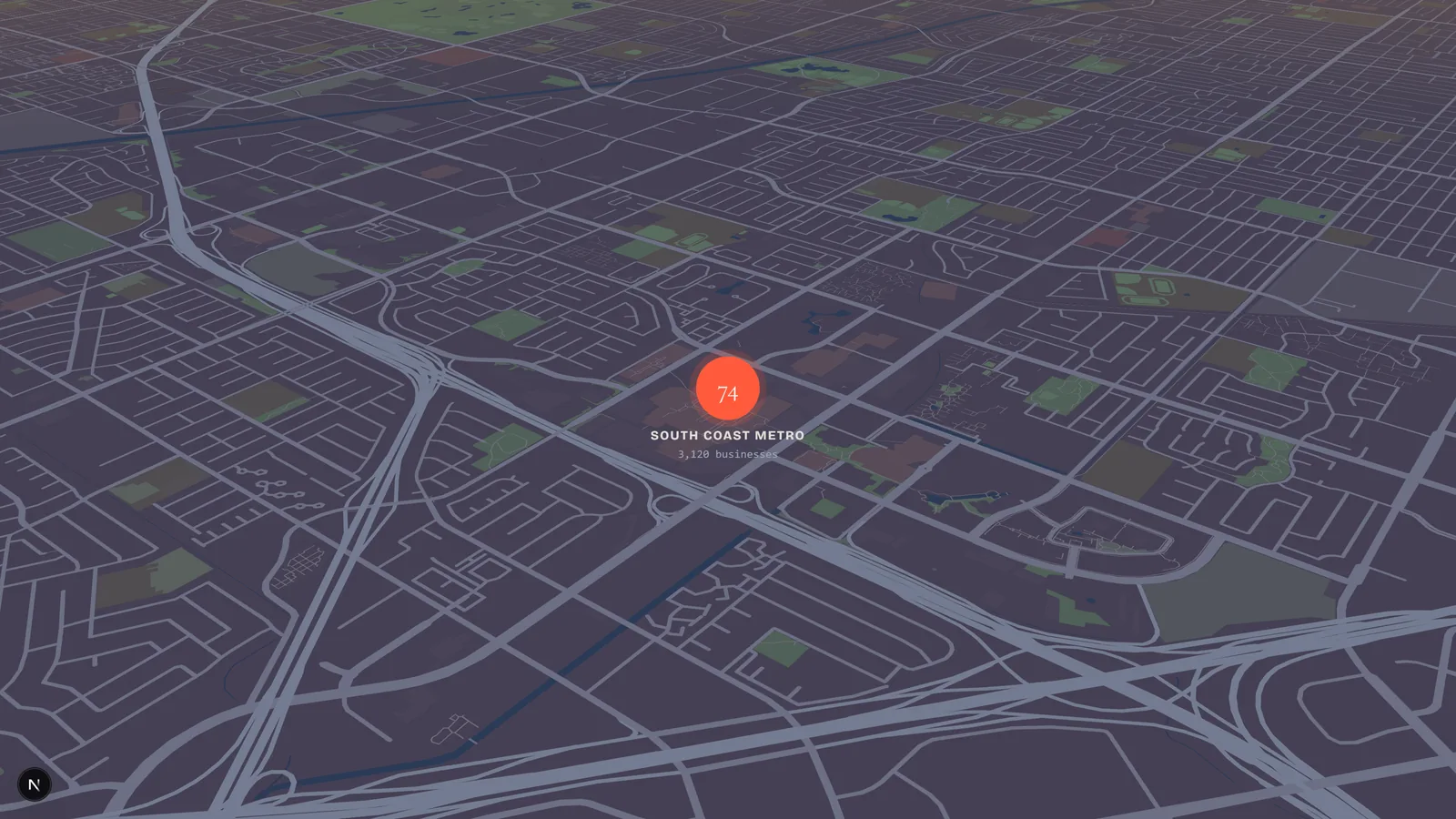
Orange County
Every block has an AI Score.
It’s how often an assistant can name a business there when a customer asks. It is not the same across the county.
South Coast Metro has the highest median AI Score in the county, at 74.
illustrative · © Mapbox © OpenStreetMap
Editorial independence
Five promises we keep.
A score is only worth something if nothing can buy it. These five hold the method honest.
Money never moves a score.
Not from the businesses we list, not from agencies, not from anyone.
Rankings are earned.
No promoted entries in any leaderboard. Every ranking is computed, then audited by a person.
Links go where they say.
No affiliate links, no monetized click-outs. We earn nothing when you follow one.
Every input is public.
Each signal that moves the score is published in full, and we date every change.
One honest category per business.
The one its customers would name first. We check for miscategorization every month.
We stand behind every score.
Editorial independence
Five promises we keep.
A score is only worth something if nothing can buy it. These five hold the method honest.
- Money never moves a score.
- Rankings are earned.
- Links go where they say.
- Every input is public.
- One honest category per business.
Not from the businesses we list, not from agencies, not from anyone.
We stand behind every score.
Find out what AI says about you.
And it’s free.
Appendix · References
Every method, cited.
The published work the AI Score is built on. None of it is ours to claim.
- 01
Lewis, Perez, Piktus, et al. (2020). Retrieval-Augmented Generation for Knowledge-Intensive NLP Tasks. NeurIPS.
RAG - 02
Karpukhin, Oğuz, Min, et al. (2020). Dense Passage Retrieval for Open-Domain Question Answering. EMNLP.
DPR + cosine - 03
Robertson & Zaragoza (2009). The Probabilistic Relevance Framework: BM25 and Beyond. Foundations and Trends in Information Retrieval.
BM25 - 04
Spärck Jones (1972). A Statistical Interpretation of Term Specificity and Its Application in Retrieval. Journal of Documentation.
TF-IDF - 05
Yamada, Asai, Shindo, et al. (2020). LUKE: Deep Contextualized Entity Representations with Entity-aware Self-attention. EMNLP.
LUKE - 06
Brin & Page (1998). The Anatomy of a Large-Scale Hypertextual Web Search Engine. Computer Networks and ISDN Systems.
PageRank - 07
Cormack, Clarke & Büttcher (2009). Reciprocal Rank Fusion Outperforms Condorcet and Individual Rank Learning Methods. SIGIR.
Reciprocal Rank Fusion - 08
United Nations Development Programme (2010). Human Development Report 2010 — Technical Notes. UNDP.
Weighted geometric mean - 09
OECD & Joint Research Centre (2008). Handbook on Constructing Composite Indicators: Methodology and User Guide. OECD Publishing.
Composite-index method - 10
Shapley (1953). A Value for n-Person Games. Contributions to the Theory of Games, Vol. II.
Shapley values - 11
Fruchterman & Reingold (1991). Graph Drawing by Force-Directed Placement. Software: Practice and Experience.
Force-directed layout
New to the registry? You can also read the Local AI Registry launch announcement.